Quick verdict
If you are listing a product on Amazon, eBay, or selling in retail stores, you MUST have a UPC (or EAN) barcode. A QR code cannot replace a UPC code for inventory tracking or product listing creation. You can use both on your packaging: a UPC for the scanner, and a QR code for marketing.
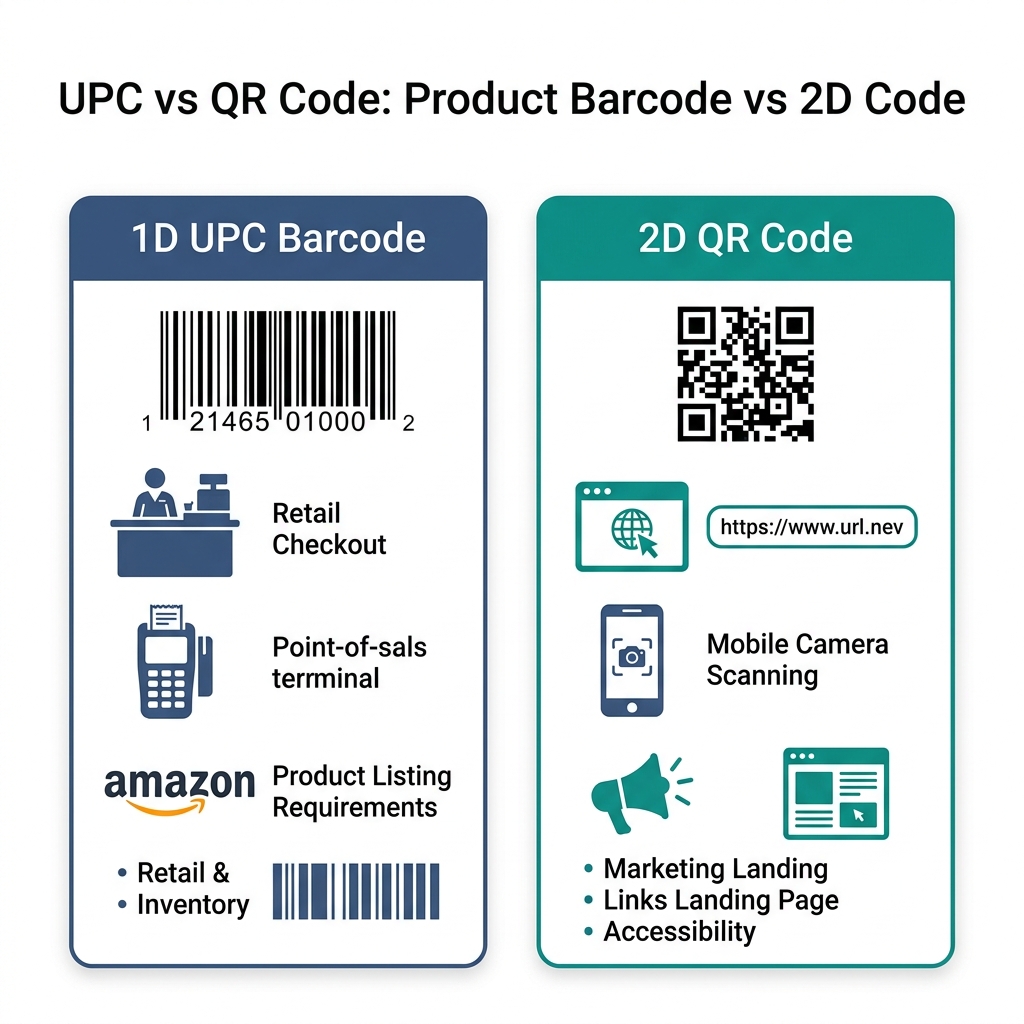
Side-by-side comparison
| Feature | UPC Barcode | QR Code |
|---|---|---|
| Code format | 1D (12-digit linear bars) | 2D (matrix dots / squares) |
| Primary purpose | Product identification & checkout | Website links & marketing |
| Amazon listing required | Yes (GTIN standard) | No |
| Retail POS checkout | Standard universal requirement | Not used for product pricing |
| Data capacity | 12 numeric digits | Up to 7,000 characters (URLs, text) |
Why Amazon and retailers require UPC codes instead of QR codes
Retail point-of-sale (POS) systems and Amazon's catalog database are built around 1D GTIN standards (UPC-A and EAN-13). When a cashier or warehouse scanner reads a 12-digit UPC, it immediately looks up the price and stock record in the store database. QR codes encode web links (URLs) or long text strings, which standard checkout scanners cannot resolve to a GTIN product catalog.
Can you put both on your product packaging?
Yes. Many modern brands print a UPC barcode on the bottom or back panel for retail checkout, while placing a QR code on the side panel inviting customers to scan for user manuals, warranty registration, or social media links. They complement each other, but the QR code never replaces the UPC.
Ready to get your barcodes?
Starting at $8. One-time, no renewal, instant delivery.